Fusionex Tech Highlights AI Vision Systems as the Future of Smart Quality Control

LONDON, United Kingdom – August 8, 2026 – As manufacturing continues its transformation into a highly automated and data-driven industry, quality assurance has become more critical than ever. Global manufacturers are under increasing pressure to deliver flawless products at faster speeds while minimizing waste, controlling production costs, and meeting increasingly stringent regulatory requirements.
Traditional inspection methods that rely heavily on manual sampling and human observation are no longer sufficient for modern production environments.
Artificial Intelligence (AI), combined with advanced computer vision technology, is rapidly redefining how manufacturers approach quality control. Rather than inspecting only a fraction of products leaving the production line, AI-powered vision systems can continuously inspect every product in real time, providing manufacturers with unprecedented accuracy, consistency, and operational visibility.
Fusionex Tech believes AI Vision Systems represent one of the most transformative innovations within Industry 4.0, enabling organizations to move beyond reactive quality management towards intelligent, predictive quality assurance that continuously improves over time.
The Growing Challenge of Maintaining Product Quality
Product quality has always been a defining factor in manufacturing success. Even minor defects can result in customer complaints, warranty claims, product recalls, reputational damage, and significant financial losses.
Today's manufacturers face increasingly complex production environments where thousands of components, automated machines, suppliers, and operators interact simultaneously.
As production speeds increase, manual inspection becomes increasingly difficult.
Human inspectors naturally experience fatigue, inconsistencies, and limitations when performing repetitive visual inspections over extended periods. Even highly experienced inspectors may overlook microscopic defects or subtle anomalies that later develop into larger product failures.
Sampling inspections also introduce additional risk.
Instead of inspecting every product, manufacturers often examine only a small percentage of finished goods, leaving defective products undetected until they reach customers.
Fusionex Tech believes manufacturers require a new generation of intelligent inspection capabilities capable of matching the speed and complexity of modern production.
AI Vision Systems: Transforming Quality Assurance
AI Vision Systems combine high-resolution industrial cameras, machine learning algorithms, deep learning models, and advanced image analytics to inspect products automatically throughout the manufacturing process.
Unlike traditional rule-based inspection software that relies on predefined conditions, AI continuously learns from production data.
The technology analyses millions of images, gradually improving its ability to distinguish between acceptable products and defects while adapting to changing production conditions.
Every captured image becomes an opportunity for continuous learning.
Instead of relying on rigid programming rules, AI recognizes subtle visual patterns that human inspectors may overlook.
These systems can identify:
Surface scratches
Cracks and fractures
Missing components
Incorrect assembly
Dimensional inconsistencies
Colour variations
Weld quality
Packaging defects
Label verification
Printed text accuracy
By inspecting every product rather than periodic samples, manufacturers gain significantly greater confidence in overall product quality.
Moving Beyond Traditional Machine Vision
Conventional machine vision systems have existed for many years.
However, these systems typically depend on predefined parameters established during initial programming.
Whenever product designs change, lighting conditions vary, or manufacturing processes evolve, engineers often need to manually reconfigure inspection rules.
This creates additional maintenance requirements while reducing operational flexibility.
Artificial Intelligence fundamentally changes this approach.
Deep learning algorithms learn directly from production images rather than relying exclusively on manually programmed rules.
As new examples become available, the AI continuously improves its detection capabilities.
This enables manufacturers to introduce new products faster while reducing engineering effort required for inspection configuration.
The result is a more adaptive and intelligent quality assurance process capable of evolving alongside manufacturing operations.
Detecting Defects Before They Become Expensive Problems
One of the greatest advantages of AI Vision Systems lies in early defect detection.
Rather than identifying defective products only after final assembly, AI inspection can monitor quality throughout every stage of production.
This allows manufacturers to detect problems immediately after they occur.
For example, an AI inspection system may identify that a particular robotic arm has gradually shifted its positioning tolerance.
Although the deviation remains extremely small, AI recognizes the emerging trend before defective products exceed acceptable quality thresholds.
Maintenance teams receive alerts, enabling corrective action before large volumes of defective products are produced.
Similarly, AI can detect changes in surface finishes, alignment, solder quality, adhesive application, or assembly consistency long before human inspectors notice visible abnormalities.
Early detection dramatically reduces:
Product rework
Material waste
Production downtime
Warranty claims
Customer returns
Recall risks
The financial benefits often extend far beyond inspection itself.
Real-Time Decision Making on the Production Floor
Modern manufacturing increasingly depends on real-time operational intelligence.
AI Vision Systems provide immediate inspection results within milliseconds after products pass inspection cameras.
Production managers no longer wait until end-of-shift quality reports to discover emerging problems.
Instead, AI instantly classifies products, flags abnormalities, and provides confidence scores supporting each inspection decision.
When integrated with Manufacturing Execution Systems (MES), Enterprise Resource Planning (ERP) platforms, and Industrial Internet of Things (IIoT) devices, inspection results become part of a broader operational intelligence ecosystem.
Production supervisors can monitor live dashboards displaying:
Defect trends
Machine performance
Product quality by production line
Operator performance
Yield rates
First-pass quality
Scrap levels
This level of visibility enables faster operational decisions while improving overall manufacturing efficiency.
Continuous Learning Improves Inspection Accuracy
Unlike static inspection systems, AI becomes more intelligent over time.
Each production cycle provides additional training data that strengthens future inspection performance.
When new defect types appear, engineers simply validate inspection outcomes.
The AI incorporates this feedback into subsequent learning cycles, continuously expanding its knowledge.
This continuous improvement process helps manufacturers maintain high inspection accuracy even as products evolve.
It also reduces dependence on highly specialized programming resources required by traditional machine vision systems.
Fusionex Tech believes adaptive learning will become a defining characteristic of next-generation smart factories.
Supporting Sustainability Through Intelligent Quality Control
Sustainability has become a strategic priority for manufacturers worldwide.
Reducing waste not only lowers production costs but also contributes to environmental responsibility.
AI Vision Systems support sustainability by minimizing defective production.
Better inspection accuracy means:
Less raw material waste
Reduced energy consumption
Lower scrap rates
Fewer product recalls
Improved resource utilization
Reduced carbon emissions associated with rework
Instead of discarding large production batches due to late defect discovery, manufacturers can isolate issues immediately, significantly reducing unnecessary waste.
This aligns quality improvement with broader Environmental, Social, and Governance (ESG) objectives.
Industry Applications Continue Expanding
AI Vision Systems are now being adopted across a wide range of industries.
Electronics manufacturers use AI to inspect printed circuit boards, semiconductor packaging, solder joints, and micro-components.
Automotive manufacturers inspect weld quality, paint consistency, body alignment, and component assembly.
Food and beverage companies verify packaging integrity, label accuracy, fill levels, and contamination risks.
Pharmaceutical manufacturers inspect blister packaging, tablet appearance, vial sealing, and serialization compliance.
Consumer goods manufacturers monitor cosmetic quality, packaging presentation, and assembly accuracy.
Although each industry presents unique challenges, the underlying objective remains consistent:
Deliver higher quality with greater efficiency while minimizing operational costs.
AI and Human Expertise Working Together
Despite increasing automation, Fusionex Tech believes people remain central to manufacturing excellence.
AI Vision Systems are designed to augment—not replace—human expertise.
Quality engineers continue defining quality standards, investigating root causes, validating AI recommendations, and driving continuous improvement initiatives.
Artificial Intelligence performs repetitive visual inspection tasks with exceptional consistency, allowing experienced professionals to focus on higher-value analytical and strategic responsibilities.
This collaboration between human expertise and intelligent automation creates stronger quality management systems while improving workforce productivity.
The Future of Intelligent Manufacturing
As manufacturing continues embracing Industry 4.0, AI-powered inspection technologies are expected to become foundational components of smart factories.
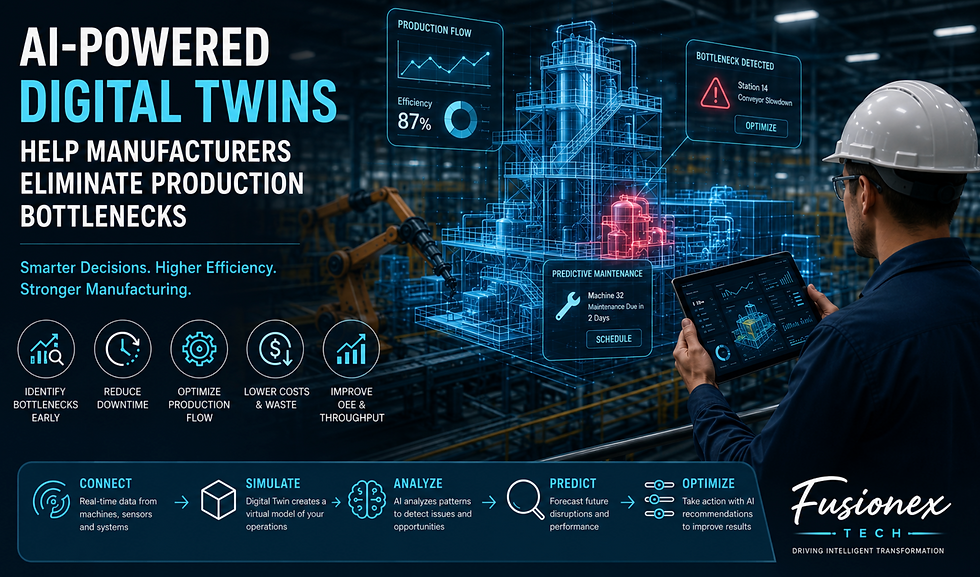
Future AI Vision Systems may integrate seamlessly with autonomous robots, Digital Twins, predictive maintenance platforms, and Generative AI assistants to create fully connected manufacturing ecosystems.
Inspection systems will not only identify defects but also explain why they occurred, recommend corrective actions, predict future quality risks, and automatically optimize production settings.
This represents a significant shift from reactive quality control towards autonomous quality optimization.
Fusionex Tech continues exploring advanced Artificial Intelligence, computer vision, machine learning, and intelligent automation technologies that empower manufacturers to achieve higher quality, greater efficiency, and stronger operational resilience.
As organizations accelerate their digital transformation journeys, AI Vision Systems will play an increasingly strategic role in helping manufacturers build smarter factories capable of meeting the demands of tomorrow's global economy.
Comments