AI-Powered Digital Twins Help Manufacturers Eliminate Production Bottlenecks
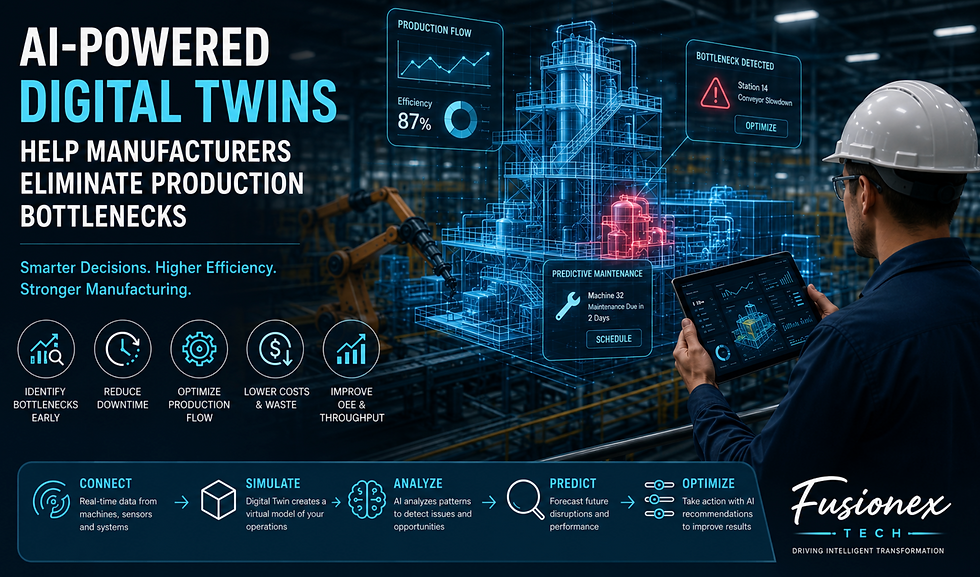
LONDON, United Kingdom – August 1, 2026 – As manufacturers continue navigating an increasingly competitive global landscape, improving operational efficiency has become more important than ever. Rising production costs, supply chain uncertainties, skilled labour shortages, and growing customer expectations are forcing manufacturers to rethink traditional production strategies. Across industries ranging from automotive and electronics to pharmaceuticals and consumer goods, businesses are increasingly turning to Artificial Intelligence (AI) and Digital Twin technologies to optimize operations, eliminate production bottlenecks, and build smarter, more resilient factories.
Fusionex Tech believes the convergence of AI and Digital Twin technology represents one of the most significant advancements in Industry 4.0. Rather than relying solely on historical reports or reactive decision-making, manufacturers can now simulate entire production environments, continuously monitor factory performance, and identify operational constraints before they escalate into costly disruptions.
The Hidden Cost of Manufacturing Bottlenecks
Every manufacturing operation experiences bottlenecks. Whether caused by aging equipment, inefficient production scheduling, material shortages, machine downtime, or workforce constraints, bottlenecks can significantly reduce production throughput while increasing operational costs.
In many factories, these constraints remain hidden until production targets are missed. Managers often rely on historical data, manual observations, or periodic reporting to identify issues, meaning corrective action only occurs after productivity has already been affected.
The financial impact can be substantial. A single production line operating below optimal efficiency may reduce daily output, increase overtime costs, delay customer deliveries, and create unnecessary inventory imbalances throughout the supply chain.
Traditional manufacturing systems often provide visibility into what has already happened. However, today's highly dynamic production environments require organizations to anticipate problems before they occur.
This is where AI-powered Digital Twins are changing the manufacturing landscape.
Understanding Digital Twins
A Digital Twin is a virtual representation of a physical asset, production line, manufacturing facility, or even an entire factory. By integrating live operational data from machines, sensors, industrial IoT devices, enterprise resource planning (ERP) systems, manufacturing execution systems (MES), and quality management platforms, the Digital Twin continuously mirrors real-world operations.
Rather than acting as a static dashboard, a modern Digital Twin becomes an intelligent simulation environment capable of predicting future outcomes based on changing production conditions.
When Artificial Intelligence is embedded into this digital model, manufacturers gain the ability to identify patterns, forecast production constraints, and evaluate multiple operational scenarios before implementing changes on the factory floor.
Instead of asking, "What happened yesterday?" manufacturers can now ask:
What will happen if Machine A experiences reduced performance?
Which production line will become the next bottleneck?
How will increased customer demand affect manufacturing capacity?
Which maintenance schedule minimizes production disruption?
What is the most efficient allocation of manpower during peak production?
AI transforms Digital Twins from visualization tools into intelligent decision-support platforms.
AI Brings Predictive Intelligence to Manufacturing
Artificial Intelligence enables Digital Twins to move beyond descriptive analytics into predictive and prescriptive intelligence.
Using machine learning algorithms, AI continuously analyses large volumes of operational data that would be impossible for human teams to process manually. The system learns from production history while adapting to changing factory conditions in real time.
For example, AI may detect that a particular assembly machine begins producing slightly longer cycle times several hours before mechanical failure becomes noticeable.
Rather than waiting for equipment breakdown, maintenance teams receive early warnings, allowing repairs to be scheduled during planned maintenance windows instead of emergency shutdowns.
Similarly, AI can identify subtle workflow imbalances between production stations. Even when each individual machine performs within acceptable parameters, small delays can accumulate across multiple processes, eventually creating significant production bottlenecks.
Because the Digital Twin continuously simulates factory operations, manufacturers can evaluate corrective actions before making physical adjustments, reducing operational risks while improving overall productivity.
Smarter Production Planning
Production scheduling has always been one of manufacturing's greatest challenges.
Customer orders fluctuate, raw material availability changes unexpectedly, equipment maintenance affects capacity, and labour availability varies throughout the year.
Conventional scheduling often depends on static planning models that cannot quickly adapt to unexpected disruptions.
AI-powered Digital Twins introduce dynamic scheduling capabilities.
By continuously evaluating production priorities alongside real-time factory conditions, AI can recommend scheduling adjustments that maximize throughput while minimizing delays.
For instance, if a critical machine unexpectedly requires maintenance, the Digital Twin can immediately simulate multiple alternative production schedules and recommend the most efficient option.
This enables manufacturers to respond faster to changing business conditions while maintaining customer delivery commitments.
Improving Overall Equipment Effectiveness (OEE)
Overall Equipment Effectiveness (OEE) remains one of the most important performance indicators within manufacturing.
OEE combines equipment availability, production performance, and product quality into a single metric that reflects operational efficiency.
Many organizations struggle to improve OEE because identifying the underlying causes requires analysing enormous amounts of production data across multiple systems.
Artificial Intelligence simplifies this process.
By correlating machine data, maintenance records, operator activities, environmental conditions, and production outcomes, AI can identify which factors have the greatest impact on OEE.
Instead of generic improvement initiatives, manufacturers receive highly targeted recommendations based on actual operational behaviour.
This enables continuous improvement programs that deliver measurable operational benefits over time.
Reducing Waste Through Intelligent Optimization
Manufacturing waste extends far beyond defective products.
Idle machines, unnecessary transportation, excessive inventory, energy inefficiencies, production delays, and material overconsumption all contribute to rising operational costs.
AI-powered Digital Twins help organizations identify waste that often remains invisible using traditional reporting methods.
For example, production simulations may reveal that changing workstation layouts could reduce material movement by 15 percent.
Similarly, AI may identify production sequences that reduce energy consumption during peak operating hours while maintaining production targets.
These improvements not only reduce operational costs but also contribute to sustainability initiatives as manufacturers seek to lower carbon emissions and improve resource utilization.
Building More Resilient Supply Chains
Recent global events have highlighted the importance of supply chain resilience.
Manufacturers increasingly face supplier disruptions, transportation delays, fluctuating raw material costs, and geopolitical uncertainties.
Digital Twins can extend beyond factory operations by incorporating supply chain data into production simulations.
Artificial Intelligence can evaluate how supplier delays affect production schedules, inventory requirements, and customer deliveries.
Instead of reacting after disruptions occur, manufacturers gain opportunities to adjust procurement strategies, rebalance production capacity, or identify alternative sourcing options before operational performance is affected.
This predictive capability strengthens organizational resilience while improving business continuity.
Empowering Human Decision-Making
Despite rapid advances in Artificial Intelligence, successful smart factories continue to rely on experienced human expertise.
Fusionex Tech views AI not as a replacement for manufacturing professionals, but as a decision-support technology that enhances operational intelligence.
Engineers, production managers, maintenance teams, and plant executives remain responsible for strategic decision-making.
AI provides these professionals with faster access to insights that previously required extensive manual analysis.
Rather than replacing operational knowledge, AI amplifies it by enabling faster, better-informed decisions supported by real-time analytics.
This collaborative approach allows organizations to combine human experience with computational intelligence for improved manufacturing outcomes.
Accelerating the Future of Industry 4.0
Industry 4.0 continues to reshape global manufacturing through increased automation, connected devices, advanced analytics, and intelligent decision-making.
Digital Twins represent one of the foundational technologies supporting this transformation.
As AI capabilities continue evolving, Digital Twins are expected to become increasingly autonomous, capable of recommending production adjustments, optimizing energy consumption, improving maintenance planning, and continuously learning from factory operations.
Manufacturers adopting these technologies today are positioning themselves to compete more effectively in an increasingly data-driven industrial economy.
The combination of AI, Industrial Internet of Things (IIoT), cloud computing, edge computing, and Digital Twins provides manufacturers with unprecedented operational visibility while enabling faster responses to changing market conditions.
Fusionex Tech's Vision for Intelligent Manufacturing
Fusionex Tech continues to advance intelligent manufacturing solutions that help organizations unlock greater operational efficiency through Artificial Intelligence, advanced analytics, automation, and digital innovation.
By integrating AI-powered Digital Twins into modern manufacturing environments, businesses can gain deeper operational visibility, improve production planning, reduce downtime, optimize resource utilization, and build more agile manufacturing ecosystems capable of adapting to future challenges.
As manufacturers continue accelerating their digital transformation journeys, intelligent technologies will increasingly serve as strategic enablers rather than optional investments. Organizations that successfully embrace AI-driven manufacturing today will be better positioned to enhance productivity, strengthen competitiveness, and create sustainable long-term growth in tomorrow's rapidly evolving industrial landscape.

Comments